Hwæt! We are back and wayfaring once more. Who needs a publishing schedule, right? My literary coracle was blown off course by the winds of restlessness and real-life festivities. Now, I’m back on the boat and paddling like mad. Last week I delved headlong into what I believe to be a piece of modern folk culture: the music festival. Expect a full exploration of tents, fireworks, and reveling and how it fits into modern perceptions of ‘folk’ very soon. Whilst that’s cooking, I’m releasing a scene of my debut play Grassman into the world today, letting it grow legs and stomp all over the place. Terrifying stuff. First, though – what’s going on in late August and early September in the world of medieval saints and modern folk?
Widecombe Fair
Widecombe Fair takes place every year on the second Tuesday of September – this year, that falls on the 9th. It’s held in the small and beautiful town of Widecombe-in-the-Moor, on Dartmoor. West of Haytor, North of Buckfast Abbey, East of Wistman’s wood, and South of Grimspound.

The stunning, remote and historically rich moorlands of England have never failed to inspire artists, musicians, and writers. Arthur Conan Doyle was moved enough on his visit to Dartmoor to base an entire Sherlock Holmes novel on the wild myth and landscape that imbues the place. Similarly, over on Bodmin, the Jamaica Inn’s roaring fires and pouring rain evoked an atmosphere perfect for Daphne Du Maurier’s Gothic novel of the same name. Was it the evocative, mysterious power of the moor that inspired Widecombe’s most famous work of art? Perhaps not.
The folk song ‘Widecombe Fair’ might not mean anything to younger readers, or indeed, anyone not from Devon. As far as folk songs with distinct regional flavour, however, it’s done pretty well for itself. This BBC Devon article on the folk song even professes (potentially optimistically) that ‘the song Widecombe Fair has traveled across the world – taken to distant shores by people who emigrated from the West Country.’ What a journey for that poor grey mare. For those of you unlucky enough not to have heard it, here are the lyrics, as they’re recorded by the Reverend Baring-Gould in their ‘official’ version from 1880’s Songs of the West.
Tom Pearse, Tom Pearse, lend me your grey mare,
All along, down along, out along, lee,
For I want for to go to Widecombe Fair,
With Bill Brewer, Jan Stewer, Peter Gurney,
Peter Davy, Dan’l Whiddon, Harry Hawke,
Old Uncle Tom Cobley and all,
Old Uncle Tom Cobley and all.
And when shall I see again my grey mare?
All along, down along, out along, lee,
By Friday soon, or Saturday noon,
With Bill Brewer, Jan Stewer, Peter Gurney,
Peter Davy, Dan’l Whiddon, Harry Hawke,
Old Uncle Tom Cobley and all,
Old Uncle Tom Cobley and all.
Then Friday came, and Saturday noon,
All along, down along, out along, lee,
But Tom Pearces old mare hath not trotted home,
With Bill Brewer, Jan Stewer, Peter Gurney,
Peter Davy, Dan’l Whiddon, Harry Hawke,
Old Uncle Tom Cobley and all,
Old Uncle Tom Cobley and all.
So Tom Pearse he got up to the top o’ the hill
All along, down along, out along, lee,
And he seed his old mare down a-making her will,
With Bill Brewer, Jan Stewer, Peter Gurney,
Peter Davy, Dan’l Whiddon, Harry Hawke,
Old Uncle Tom Cobley and all,
Old Uncle Tom Cobley and all.
So Tom Pearse’s old mare, her took sick and died,
All along, down along, out along, lee,
And Tom he sat down on a stone, and he cried
With Bill Brewer, Jan Stewer, Peter Gurney,
Peter Davy, Dan’l Whiddon, Harry Hawke,
Old Uncle Tom Cobley and all,
Old Uncle Tom Cobley and all.
But this isn’t the end o’ this shocking affair,
All along, down along, out along, lee,
Nor, though they be dead, of the horrid career
Of Bill Brewer, Jan Stewer, Peter Gurney,
Peter Davy, Dan’l Whiddon, Harry Hawke,
Old Uncle Tom Cobley and all,
Old Uncle Tom Cobley and all.
When the wind whistles cold on the moor of a night
All along, down along, out along, lee,
Tom Pearse’s old mare doth appear gashly white,
With Bill Brewer, Jan Stewer, Peter Gurney,
Peter Davy, Dan’l Whiddon, Harry Hawke,
Old Uncle Tom Cobley and all,
Old Uncle Tom Cobley and all.
And all the long night he heard skirling and groans,
All along, down along, out along, lee,
From Tom Pearce’s old mare in her rattling bones,
With Bill Brewer, Jan Stewer, Peter Gurney,
Peter Davy, Dan’l Whiddon, Harry Hawke,
Old Uncle Tom Cobley and all,
Old Uncle Tom Cobley and all.
There is also a fantastic version of this song by Goblin Band, which you can listen to on SoundCloud here. I would seriously recommend checking out their other stuff too. Folk music is made to be heard and enjoyed, after all, not studied. For more on the name analysis and history of the song, have a gander at the BBC Devon article linked above.
I’ll forever be thankful to this folk song for giving us the common phrase ‘uncle Tom Cobley an’ all’, a much more interesting way of saying ‘and the rest/ et al.’ etc. Not only does this folk song give an insight into the lives of those living in mid-Devon in the early 19th-century, but it gives us in the modern day some bits to reflect on as well. Is there something in here about greed? About selfishness? Certainly about animal cruelty at the very least (RIP to the grey mare). Like all good moral tales, the baddies get their comeuppance at the end: a good haunting by a ghost horse.
The Widecombe Fair that exists today is still going strong. The blood that runs through the fair is firmly agricultural, providing local farmers a place to display their livestock, socialise, and ‘compare the size of their tractors’ according to the Widecombe Fair website. The modern fair honours its roots with the ‘Uncle Tom Cobley’ race. It’s a pretty brutal affair:
Competitors are driven to an undisclosed location somewhere upon the hills overlooking Widecombe village, then required to get back to the fair field as fast as possible without the use of roads, footpaths or bridleways. (Widecombe Fair website)
Sadly no grey mares about to hitch a ride on.
There’s some very Dartmoor-specific events: the Dartmoor Pony Display Team, for example, or the bale tossing, which I haven’t seen represented in many other agricultural fairs. There’s also ferret racing, baking competitions, dog shows, livestock shows, veg competitions – everything you’d expect from a ‘quaint’ English agricultural show. I’ve never been sure about the word ‘quaint’ being applied to events like this. Or any rural event, really. There’s a certain level of distance, of judgement, of a patronising smile. The big city comes over to the village, looks at the products of its history and culture, pats it on the shoulder and says ‘Aw. Isn’t that quaint?’ I think a better word could be enchanting. Impressive. And even then, the world of the moor is excluded. Bleak and beautiful. Widecombe Fair is, and has always been, a coming together of people, a celebration of life and they rural way of living it, in an uncompromising environment. Perhaps, then: enduring. Intrinsic. Essentially human. And just bloody fun.
I could go on about agricultural and town fairs ad infinitem, so I ought to move on now or we’ll be here till next year. See the Widecombe Fair website linked above for some more info, and to get tickets for next week! I dare you to go up to one of the blokes doing the tug of war and call him quaint. See if he agrees.
St Æbbe the Elder
Now for our medieval saint of the week! I’ve accidentally continued the tradition of focussing on the Northumbrian royal family (in my defence, they were all pretty iconic). St Æbbe’s feast day is the 25th August which is, as per usual with saints, the day of her death.
St Æbbe was born c. 615 AD, to royal parents Æðelfrith and Acha. Æðelfrith was a non-Christian king of Bernicia, locked in a feud with Edwin, king of Deira. Acha, as many women have been since and shall be again, was a woman caught in the middle of male violence and greed for power and domination. Æðelfrith drove Edwin into exile in and reportedly tried to have him murdered. Acha was Edwin’s sister, and, of course, Æðelfrith’s wife. Can you imagine the Christmas dinners? Awkies. Luckily, they were all pagan at this point and Christmas didn’t exist.
Æðelfrith is killed c.616 in battle with Raedwald of Mercia, after which Edwin succeeds the throne of both Deira and Bernicia. It’s around this time that Æbbe was born, and Acha, her mother brings her and her brothers into exile in Dál Riata to protect them from the danger her newly-crowned brother poses. Those brothers include Oswald and Oswiu, who we met last week. What a bunch!
Dál Riata encompassed much of what is now western Scotland, north-eastern Ireland, and all those lovely islands in-between. At this time in the 7th century, Dal Riata was a bit of a stronghold for that uniquely Irish strand of early-medieval Christianity, fostered by St Columba and the community of Iona. In exile, Æbbe and her siblings converted. When her brother Oswald returned, united Deira and Bernicia to loosely become one entity, ‘Northumbria’ (North-of-the-Humber), Æbbe was free to return and begin her work. And boy did she rise and grind.
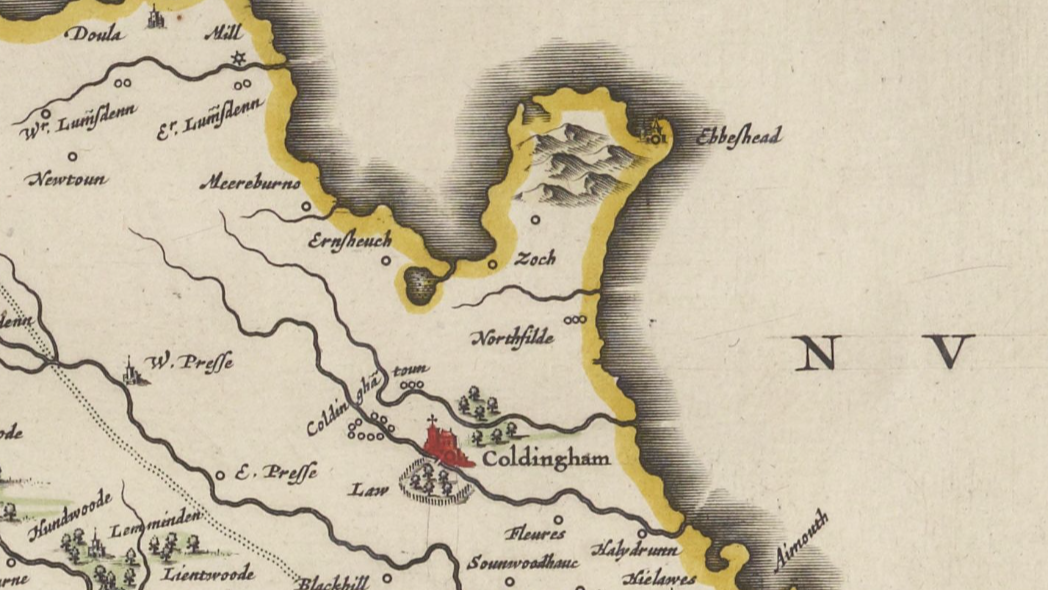
She became a nun (potentially to avoid the advances of Aidan, a Dal Riatan prince), and established her first monastery at Ebchester, under her brother’s royal protection. Then, sometime around 640×650, she then established her most important centre, a double house near Coldingham. Though the centre itself was likely built on the rocky headlands near St Abb’s Head, right on the edge of the country, rocked by the sea, it’s usually referred to by Coldingham, its nearest town. A double house is a distinct feature of Celtic Christianity at this time, and is a centre that houses both monks and nuns. How scandalous. With Æbbe as the Abbess, the centre flourished, and was a hub of learning and advancing Celtic Christianity across Northumbria. St Cuthbert was a visitor to Æbbe’s monastery, and the two seemed to be connected – maybe even friends in their faith. Indeed, Coldingham was the site of one of Cuthbert’s most well-known miracles. Known to bathe in the sea on his visits, Cuthbert was watched one especially cold winter’s day by a brother at the monastery. Cuthbert emerged from the sea, and was followed by two otters. Miraculously tame. They licked his feet until Cuthbert was warm enough to walk back to the monastery.
Æbbe herself was noted for her piety, and seems to have lived a relatively calm life for an exile, a saint, princess, and abbess. I suppose you can see through the years there to a human truth. Perhaps after such an incredibly turbulent childhood, she wanted to inject a bit of peace back into her life, and into Northumbria. Sadly, her monastery had a little bit of turbulence left to give. The community at Coldingham apparently grew harder to control, as more young royals and nobility called it home, and supposedly disregarded their vows in favour of general waywardness. Adomnan, Abbot of Iona, prophesised that this waywardness was asking for trouble (not Adomnan’s own words), and that Coldingham would burn down as a result. Indeed, after her death in 683, the prophecy was realised – Coldingham burned to the ground.
Overall then – Æbbe! What a woman. A success of perseverance and faith. I would love to be able to talk to her about her exile, her return to Northumbria, the power she held and Coldingham. The early medieval church afforded surprising power and respect to women (mainly just abbesses). I’d love to know how she worked with her male contemporaries. I’ll go into this in more detail soon. I have an old uni essay just WAITING to be re-written.
It feels important to note that Æbbe the Elder was not the only Æbbe to be the abbess at Coldingham. Shortly after her death, Coldingham was rebuilt and re-established, thriving until the onslaught of viking raids that battered the country throughout the 9th century. In 870, Abbess Æbbe the Younger faced a viking raid. To save herself from r**e at the hands of the vikings, she sliced off her nose in an attempt to make herself unappealing. Her nuns followed suit. The vikings set fire to the monastery, killing Æbbe and the entire community. Bravery echoes. Both women deserve their places in the books.

Grassman – the Opening, Myth and Modernity
Time for the good stuff. This week I’ll be sharing a scene from my play Grassman, which I’ve been working on for a long time. Longer than I care to admit. I would love nothing more than to see this play professionally produced one day. Unfortunately, I’ve not helped myself: this play has four different settings (including a realistic moor complete with tree, standing stones and moss, and a fully scaffolded thatch roof), complex and ever-present sound design, potentially actual wind and rain at points – but, hey! I only need five actors! That’s gotta be a plus, right producers? It might be my Careless Whisper, my Goodwill Hunting – that project you keep ticking over for 5-10 years until you have the money and clout to finally make it perfect. Or maybe it’ll be on next year. Who knows?
Either way, I love this play. I love the characters and the setting and the magic. It’s through writing this (now on its second full draft) that I learned to follow my instincts as a writer, and write exactly what I envisage, instead of second guessing what people expect to see. And for that, I am grateful. Theatre for me is a place for modernity and myth to blend together, and that’s what I hope this play might achieve one day. A space for recognition of universal human truths about faith, friendship, and prejudice, set against the elemental powers of folk, landscape, and the supernatural. Oh – and make it funny. So. Not too much to be working on there.
This scene is the first one I ever wrote for Grassman, nearly 2 years ago now. The ideas had been stewing in my head over summer. I’d been learning about my own local folklore on Dartmoor, drawing weird shadowy Old Crockern-esque figures all over my notebooks and feeling my own complex relationship to my hometown ever deepen. So with all that swimming around in the ol’ noggin, I took off to Dartmoor in late November with my then-partner and my then-dog (RIP Jasper, the best boy). Helpfully, I had a writing deadline looming, as I needed 10 pages of a script to apply for the Pentabus Young Writers National Scheme at the end of the week (a scheme which I cannot recommend enough! Follow this link to read some more about it. Apply if you’re a rural/regional writer!) So, in between some wonderfully atmospheric snowy walks and me reversing my car into a pole on an icy road (lol), I sat down and wrote those first 10 pages. Where better to start than at the beginning?
…
Blackout. A creature wakes up, stretches, cracks its bones.
SMACK. SMACK, SMACK, SMACK-SMACK. SMACK. SMACK, SMACK, SMACK-SMACK.
In the dark, the sound of wooden sticks smacking into each other is repeated in the rhythmic motion of a Morris dance. Just the sound of wood on wood.
SMACK. SMACK, SMACK, SMACK-SMACK. SMACK. SMACK, SMACK, SMACK-SMACK.
Bells fade in, voices whisper, the trees bend – the noise grows into a soundscape. Lit dimly by the embers, two female figures kneel by the fire. A figure skips about the plain, two great antlers jutting from either side of his head. He is surrounded by dancers, pixies, sprites, spirits. One of the women (JULIA) rises and joins the dance. They move in time to the sound of the Morris sticks.
SMACK. SMACK, SMACK, SMACK-SMACK. SMACK. SMACK, SMACK, SMACK-SMACK.
The figure by the fire (BECKY) rises and grabs one of the antlers out of the grasp of the male figure (STAN). The dancers vanish.
SCENE 1
The sound stops suddenly, and lights come up on a late summer evening spent drinking on the edge of Dartmoor. A place where myth and the tangible world sit together. Early September. A fire burned to embers, discarded bottles of Rattler and plastic milk-cartons with dregs of home brewed cider swilling in the bottom. Lumps of granite – fallen standing stones – tufts of scrub and grass, a lonely tree. Coats and backpacks lie discarded beneath the branches.
BECKY You look like a dick. Both of you do.
STAN grapples with BECKY to retrieve his antler.
STAN Finders keepers, Becks.
JULIA Those are the rules.
STAN regains the antlers and holds them above his head in triumph. JULIA and BECKY laugh along.
STAN No man – or woman – can touch my crown.
JULIA Yes!
BECKY Jesus Christ.
STAN None, not even the gods of old could lay claim to my lands. Not Woden, Thunor, Frig… um…
JULIA Tiw!
STAN Or Tiw could pass the bounds of the moor. Gods with their shallow, armless promises of peace, clodding carelessly over my marsh –
JULIA Bring them down!
STAN Swallowed by the black of bog, their worthless gold bobbing back to the foot of the spring, the pools, the dark meres of rock and frost.
JULIA What about men?
STAN Oh – men! Selfish, and strident men. They have no place here among the heather, among my creatures.
BECKY I thought you liked boys, Stan?
JULIA Call him by his / name, Becky –
STAN /Insolent child!
BECKY Oh my god. You’re ridiculous.
STAN Impertinent Wee-land once trespassed / on this –
BECKY It’s Way-land.
STAN What?
BECKY It’s spelt Weland but it’s Way-land, not Wee-land.
STAN Is that true?
JULIA Yeah, it is, she’s right.
STAN I knew that. Slip of the tongue.
BECKY Right.
JULIA grabs the antlers from STAN and holds them above her head, continuing the bit.
JULIA / Weland was mine, my captive smith. He stole into my lands and took the shinbone of my steed to set in a circlet for his king –
BECKY Your captive was he?
JULIA Yes! I took him down one night in the shadow of Scorhill, I brought him in tatters to the clapper bridge, drowned him slow in the river, caught him fast in the gorse, let him know that here be devils!
STAN (Raising a glass) Here be devils!
BECKY Here be devils!
They laugh.
STAN Who are you?
JULIA Good question. (She thrusts the antlers at BECKY) You can answer this one.
BECKY I don’t think so, I’m not gonna take the piss / out of him –
JULIA / You’re not taking the piss, it’s a tribute / to him –
STAN / We’ve both managed it, and we’ve not been ripped to bits, not / yet anyway –
BECKY / Not yet! Yes, exactly, not yet – it’s disrespectful –
JULIA Imitation is the highest form of flattery.
BECKY finds herself standing behind the dying fire, the antlers in her arms. She slowly raises them, to whoops and cheers from JULIA and STAN, starting begrudgingly but getting into it.
JULIA (Clicking her fingers) Give it to us!
STAN Go on, Becks.
BECKY I… am Old Crockern.
JULIA and STAN cheer.
BECKY Leader of the wild hunt, keeper of the whist hounds.
JULIA Where do you live?
BECKY The crags of Crockern Tor are mine, but I live nowhere. I am beyond life, little one.
STAN (To JULIA) Obviously.
BECKY Grey scarps of granite slice up my home, cutting through the sweeping hills and jutting into deepest woodland, disturbing the step of the hare and fox and boar. My meres are deep with serpents and draca, hot with bubbling flame on the flood, spouting gore at any who dare disturb the black waters.
JULIA (Shouting with glee) What do you do to them?
STAN What do you do?
BECKY (Playing her crowd) To who?
JULIA The interlopers! /
STAN / The intruders! /
JULIA / The grockles! /
STAN / The Tories! /
JULIA / Alexander Darwall! /
BECKY Fettered in frosts, I take them by the bones and drag them to my granite halls. Bound by their greed, they rot in rock in the darkening chill, and hear the scraping bones of my steed as I make back off into the night to step the borderlands once more. I let them know that here be devils!
JULIA/ STAN Here be devils!
JULIA and STAN cheer. BECKY gives a bow and sits back down. She is suddenly self-aware. Julia grabs her a bottle.
JULIA So much for not taking the piss.
BECKY I didn’t! I meant it.
JULIA Well, rather you than me. Wouldn’t want to invoke anything… unsavoury.
BECKY Shut up.
JULIA leans her head playfully on BECKY’s shoulder.
JULIA I thought it was very rousing.
BECKY It was better than yours.
STAN Better than mine?
JULIA Never.
STAN Thought so.
JULIA playfully tackles STAN.
STAN Ow! Becky – help!
BECKY I’m not getting involved. I’m sure you can take her.
STAN (Pinning STAN down)I’m not.
JULIA releases STAN.
BECKY It’s actually been pretty peaceful without you two.
STAN Oh, perfect, then.
BECKY Pretty good, yeah.
STAN I’m jealous, to be honest.
JULIA Yeah?
STAN Oh absolutely. It’s my lifelong dream to be holed up in a damp little village with chequered slippers, a pipe, and a blanket for my knees by the age of twenty-five. Peaceful.
BECKY I don’t have a pipe.
JULIA But you do have the chequered slippers?
BECKY I get cold feet.
JULIA You’re so ridiculous.
BECKY Perks of having a job, mate. Can buy myself things.
JULIA I have a degree.
BECKY Big earner, is it? The old degree?
STAN God, I am gonna miss this.
BECKY You still planning on going?
STAN You know why, Becks. I can’t stay home.
BECKY You could stay with me. You know you could, I’ve got a spare room.
STAN It’s a small town. He’d see me, he sees everything.
JULIA Your dad’s not Sauron.
STAN He kind of is. If Sauron worked in the Post Office.
JULIA Maybe if Sauron had more of an ear for gossip things would have panned out differently for him.
STAN Maybe.
BECKY The option’s there, though, my love. If you can take it, do.
STAN I don’t know where I’ll go, I don’t have anything lined up.
BECKY Does he know you want to?
STAN No, are you kidding? I was just going to get it sorted, something solid, and go. Maybe leave a note.
BECKY Really? A note, that’s it? I know he’s – you know, whatever, but –
STAN You’d do the same, believe me.
JULIA It’s nice. It’s dramatic. Like the Wanderer.
STAN Earth-weary, fix in fetters my saddened spirit –
JULIA Deprived of fatherland – wretched and woeful on the paths of exile.
STAN Wretched. Cheers. Anyway, it’s not same thing. Not as romantic as a poem, is it, a black eye.
BECKY And what if you did say something?
STAN I think he might kill me.
Beat. STAN smiles. Strained.
Don’t make me worry.
Thanks though. I’ll think about it. I’ll bear it in mind. Becky. Thank you.
BECKY Tell me when, though. When you go. Don’t just leave.
STAN Of course, I’m not a dick.
Beat.
STAN You know, you’re right. When you two aren’t fighting, it’s actually quite peaceful up here.
JULIA Peace is overrated. You want to get out a bit.
BECKY Do I?
JULIA Yep.
BECKY I want that, do I? Didn’t realise uni had given you the power of telepathy as well as forty grand of debt.
STAN It’s one of the little known perks.
JULIA Weren’t you lonely here, Becky?
Beat.
BECKY I’ve done okay. I wasn’t on my own. Believe it or not, I have other friends.
JULIA (Playfully) Okay.
STAN She’s got the lads from thatching, remember?
JULIA does not remember.
JULIA Oh… yeah.
BECKY Christ, you were only with them on Monday, thought they’d have made a bit more of an impression.
JULIA No, they were lovely, really. Quiz night isn’t really my thing.
STAN What was his name? The little one who kept putting George Michael on the Jukebox?
BECKY T.J.! Ah, I knew you two would get on!
STAN Looked to me like you two were getting on pretty well.
BECKY We should go for a drink after work tomorrow, all four of us –
STAN Yes!
JULIA Maybe.
STAN Why not?
JULIA Those guys? They’re sweet and all but – /
BECKY / it would only be T.J. /
JULIA / I don’t think I’ve got a lot in common with them.
BECKY You’re being a massive snob.
JULIA Ah, don’t take it personal. That’s me, king snob, it’s because I want you all to myself –
T.J. enters, still in his work clothes, taking off his backpack. BECKY hurriedly stands to hug him.
T.J. Knock knock.
BECKY T.J.! /
STAN Alright mate! What’s up.
T.J. Yeah, good thanks. Can’t complain.
BECKY How’s your mum?
T.J. Good today, thanks.
STAN Julia was just talking about you.
T.J. Oh yeah? Not like her.
BECKY and STAN laugh.
JULIA Just the pub quiz.
T.J. Yeah, not my finest hour. But that’s what you’re there for Jules, you’re the brains of the operation.
STAN Yeah, Jules.
T.J. Oh – sorry, is it not – I thought Jules was fine –
JULIA It is, it’s fine. I prefer Julia.
T.J. Noted. Julia.
T.J. smiles at JULIA genuinely. She politely smiles back.
JULIA If only there was a round on Plymouth Argyll or something.
T.J. Not my area, really. Ask Danny for that, and Bristol Rovers. Bake Off Winners past and present. Now that I could have a proper crack at.
BECKY You’d wipe the floor on Bake Off Winners Past and Present I reckon. It’s amazing, he has this like encyclopaedic knowledge.
STAN Pre or post move to Channel 4?
BECKY Both.
STAN People who stopped watching it after the switch are snobs, the lot of them. Sure, we all miss Mary Berry, but get over yourself, watch the ads.
T.J. The cake or not cake one they’ve started doing has blown my mind on several occasions.
JULIA Really?
T.J. God I would love to have a go at it. The surprise cake thing. Never seen one in real life, only online.
STAN How do you know? If it was a really advanced one, sitting in plain sight – you pass by thinking it’s a ticket machine or a dog or whatever, but actually – cake.
T.J. Oh my god, you’re right.
BECKY What’s your plan for Saturday?
T.J. Not sure. I was thinking coffee and walnut.
STAN No, no / I wouldn’t chance that –
BECKY / T.J., mate. Way too divisive.
JULIA Too divisive?
T.J. Really, too divisive?
STAN Absolutely. Who’s judging?
T.J. Not sure. Usual crowd probably. Parish lot.
BECKY I reckon a coffee and walnut cake could kill Pattie Chancer.
T.J. And one of those surprise-I’m-not-a-shoe cakes wouldn’t?
BECKY Fair point. Worth the risk either way so go for the showstopper. Do a snake or something.
STAN Do Old Crockern.
T.J. Who?
JULIA Becky’ll tell you.
T.J. I might stick to the classics.
JULIA All the guys from thatching gonna be there?
T.J. Danny’s running the- / oh, sorry you go.
BECKY Danny’s gonna be- / oh, sorry, you sure?
T.J. Yeah.
BECKY Okay. Danny’s running the whack a rat, the Cox twins are doing the human fruit machine-
JULIA Don’t you need three people for those?
BECKY Yeah, ideally, but they’re twins aren’t they? Not triplets. Aren’t you meant to be the clever one?
STAN Do you two have work tomorrow?
BECKY Yeah. (Realising) Shit! Yes, yes we have.
T.J. It’s fine Becks, it’s not that late.
BECKY We’re doing Andy Bowden’s roof, I’ve got to be up a ladder at six to finish those fucking ridiculous eaves. I mean, who requests six thatch foxes. SIX. Do you know how long it takes to make one of those things?
She gathers her things with haste and looks back at JULIA and STAN.
(Cont’d) Andy Bowden? Mr Bowden?
JULIA and STAN look blank. BECKY is exasperated.
T.J. Mr Bowden – butcher? Big hands?
BECKY Do you two not remember anyone?
STAN Let’s have that drink tomorrow, Becks, T.J.. Julia too!
T.J. Ah, sounds lush.
BECKY Sure – text me – bye!
BECKY and T.J. leave.
JULIA Who even is T.J.? I don’t remember a T.J..
STAN You never remember anyone’s names.
JULIA I’m not a names person.
STAN It’s not even a full name. It’s initials.
JULIA Arguably harder to remember.
STAN Are you jealous?
JULIA No. I just – don’t remember him.
STAN He didn’t go to college with us, that’s all.
JULIA Where’s he from then?
STAN I don’t know. What does it matter? He moved from Minehead, I don’t know anyone from Minehead.
JULIA Grim.
STAN You can’t hate someone for being from Minehead. They’ve got enough to deal with as it is.
JULIA begin to gather her things.
STAN Home then? Are you going to come pub tomorrow?
JULIA I’ll think about it. I’ve got some work to do.
Are you going to take your precious antlers?
STAN looks at where they lie on the ground. Watching them as if they might move.
STAN No, I don’t think so. Leave them here. They don’t belong in my room, I’d feel guilty, like they wouldn’t want to be there. I don’t want to turn them into trespassers.
See you tomorrow.
STAN leaves. JULIA lingers for a moment. She strides to the antlers and takes them with her as she leaves.
The soundscape of the moor fades as night falls. Voices, movement, bodies at night, shifting across the space, chatters. A voice, or voices, rise out of the chorus, whispering in an unknown language. The sun rises.
And there she blows. Scene 1 of currently (pending the edit) too many. It’s going to be snazzy as hell. I did a wonderful reading of Grassman with friends last September – maybe I’ll do another. Make it an annual tradition until the West End transfer (lol). I think I need to work out a better way of formatting playscripts-for-blog. Maybe that’ll be this week’s task. I cut my foot open (only very slightly) on my whittling knife so nothing too strenuous for this Peregrinus atm. Though I do feel a sea swim calling right now…
See you next time!
P x
 PEREGRINI